
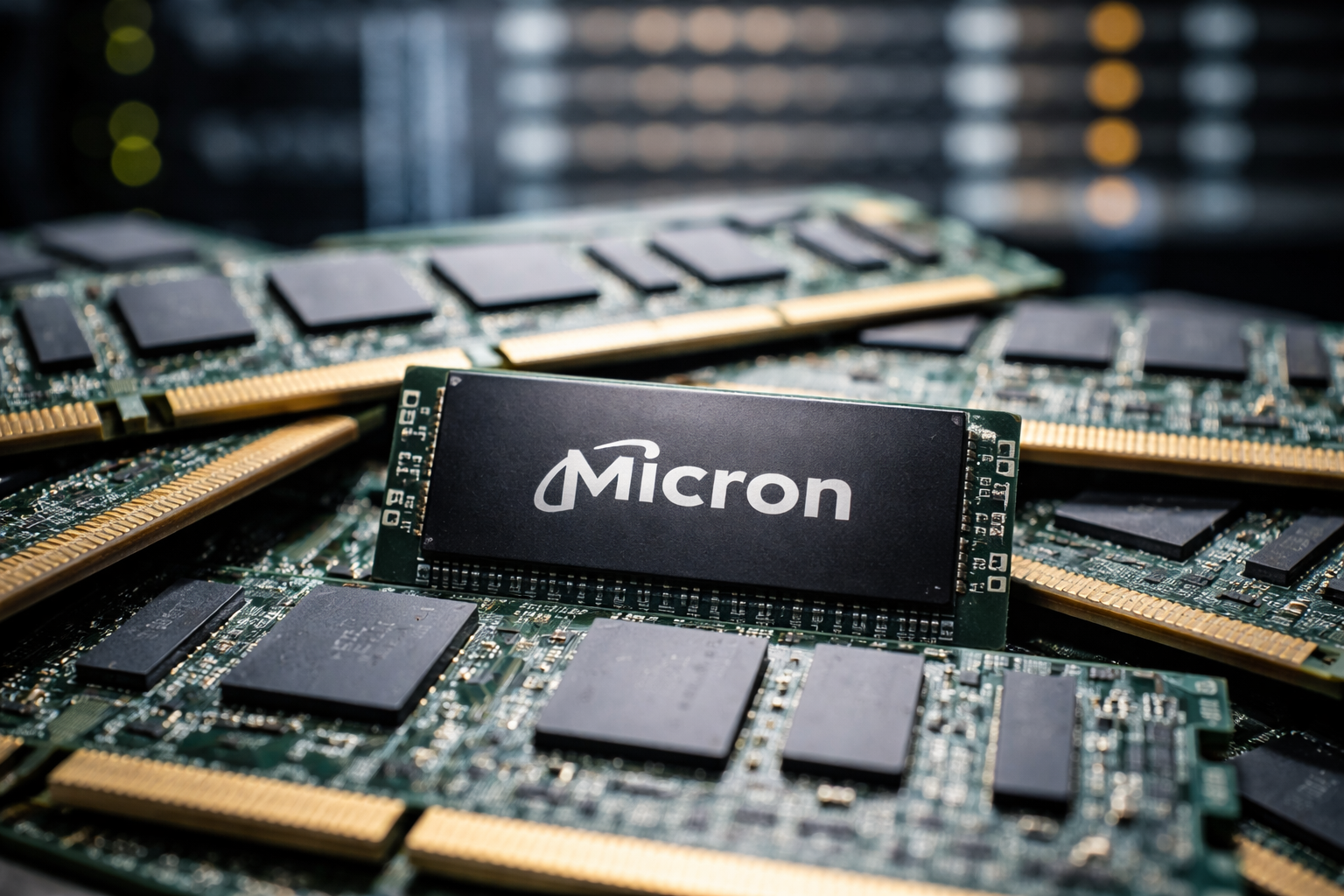
Micron stock (NASDAQ: MU) has fallen roughly 22% from its record high, sliding to around $985 on Monday after touching an all-time high near $1,255.
The drop looks jarring because the memory-chip maker only recently posted record quarterly results and upbeat guidance.
The selloff has shifted the debate from Micron’s earnings strength to valuation risk, with investors weighing an overheated AI chip trade against a memory market that remains unusually tight.
Micron stock: What actually triggered the selloff
The latest pullback does not appear to be a Micron-specific blow-up, but part of a broader reset across the AI hardware trade after a blistering rally in memory and storage stocks.
Meta’s reported move to build a third-party AI compute business rattled investors because it was read as a possible sign that some hyperscalers may eventually have excess capacity to sell.
That hit sentiment across chipmakers and AI infrastructure names, not just Micron.
The analyst linked MU’s drop to Meta’s cautious data-centre signals and broader worries about whether the memory boom can sustain its momentum.
The selling also came after a huge run.
Even after the pullback, Micron remains up more than 250% year-to-date. That makes the 22% fall look less like a collapse and more like profit-taking after a powerful AI-driven run.
Hedge-fund positioning may have amplified the move.
As per Goldman Sachs, US hedge funds had sold technology hardware stocks for a fourth straight week ahead of earnings season, reflecting caution after sharp semiconductor gains.
Why Wall Street is not panicking
Analysts remain broadly constructive because the fundamentals still look strong.
Micron reported record fiscal third-quarter revenue of $41.5 billion, up from $23.9 billion in the prior quarter and $9.3 billion a year earlier.
Non-GAAP net income came in at $28.9 billion, or $25.11 per diluted share, while operating cash flow reached $25.4 billion.
Bank of America’s Vivek Arya raised his Micron price target to $1,500 from $950 while keeping a Buy rating.
His bullish view reflects the idea that AI infrastructure is shifting from a pure demand story to a physical bottleneck story, where memory, chips and power remain scarce.
Citi’s Atif Malik has also stayed upbeat as the analyst raised his target to $1,200 in June, citing better-than-expected memory pricing, strong data-centre demand and constrained supply.
UBS is even more bullish as analyst Nicolas Gaudois viewed the latest dip as a buying opportunity and kept a $1,625 target, citing persistent memory-industry strength and tight supply.
The case for caution
Still, the buying-window argument is not risk-free.
Michael Burry has reportedly taken a short position against Micron, while questioning whether the stock’s surge reflects AI hype rather than sustainable value.
There is also the classic memory-cycle risk, as today’s shortage can become tomorrow’s glut if rivals add too much capacity.
Samsung Electronics and SK Hynix plan a combined $2.1 trillion in long-term investment, a scale that could eventually pressure pricing if AI demand cools or supply arrives faster than expected.
The post Micron stock crashes 22%: is this AI chip selloff a rare buying chance? appeared first on Invezz
