
Paying cash at the register could now cost you a penny or two more than someone paying with a card.
A new federal law lets stores round cash totals to the nearest nickel, but only when they can’t make exact change.
The Common Cents Act, signed by President Donald Trump on Nov. 20, establishes nationwide rules for retailers dealing with the penny shortage. It also directs the Treasury Department to stop making pennies for general circulation, except for collectors, according to the White House.
The U.S. Mint struck its last pennies in November 2025, nine months after Trump ordered production to stop. Since then, penny shortages have made it harder for some stores to provide exact change.
Also Read: Hershey turns back the clock with a deal that costs just pennies
The law took effect immediately, so retailers can already use the new federal rounding rules. But stores don’t have to round, and they can always round in the customer’s favor. Pennies already in circulation remain legal tender.
The change lands just ahead of Black Friday, when stores handle heavy holiday traffic and plenty of cash.
But the new rules come with limits, and a store that gets them wrong could still face lawsuits or government enforcement, according to Christopher Phillips, a payments lawyer at Holland & Knight.
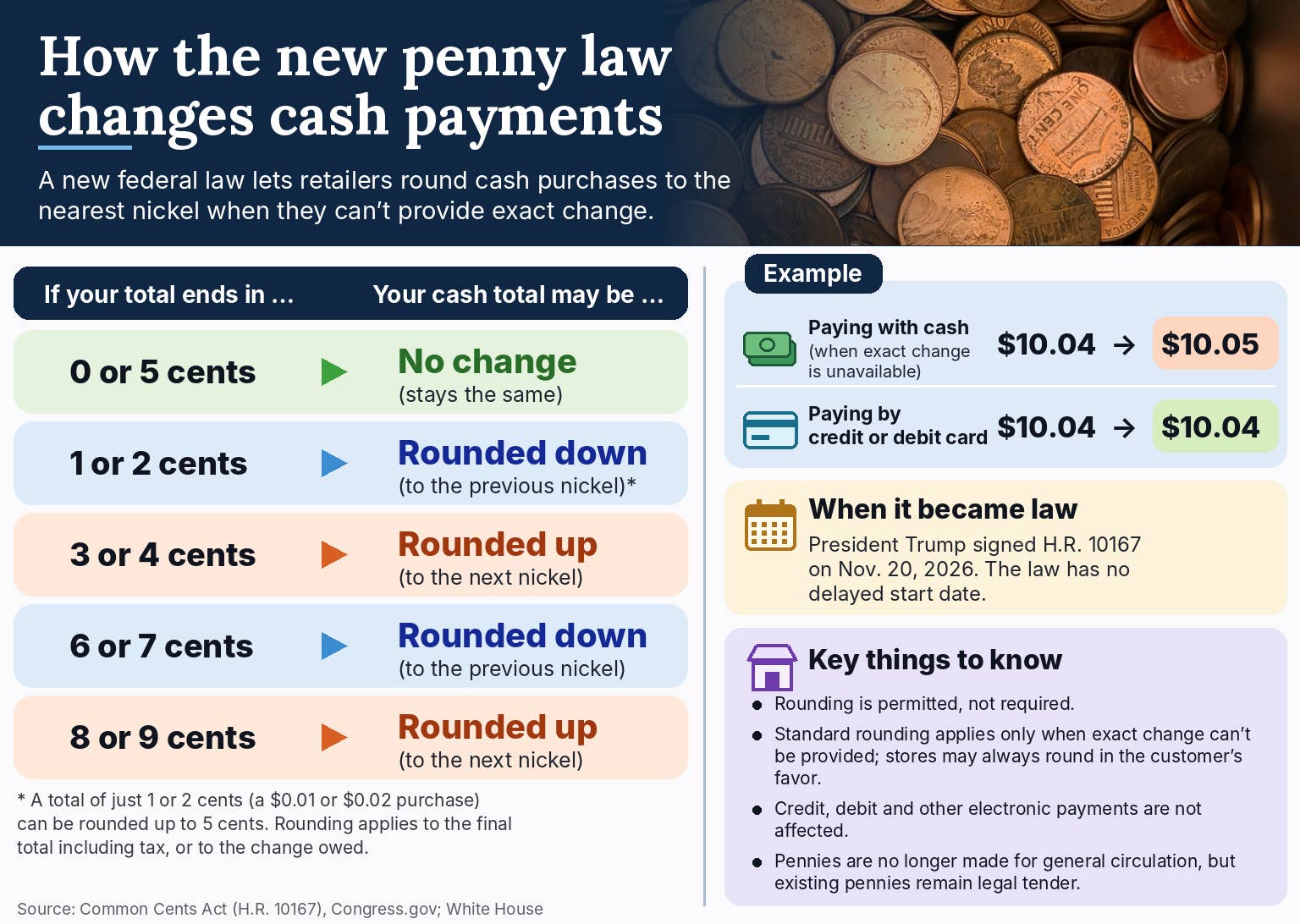
How the new penny law changes cash payments
The rounding applies to the final total, including tax, or to the change a customer is owed. It does not apply to the price of each item.
Take a $10.04 cash purchase. It can become $10.05 if the store can’t make exact change. The same purchase stays $10.04 on a credit or debit card.
Here is how totals break down:
- Ending in 1 or 2 cents: rounded down to the nearest nickel
- Ending in 3 or 4 cents: rounded up
- Ending in 6 or 7 cents: rounded down
- Ending in 8 or 9 cents: rounded up
- Ending in 0 or 5 cents: unchanged
There is one exception. If the entire cash total is just 1 or 2 cents, a store can round it up to 5 cents, according to the text of the law on Congress.gov.
Graphic: Kelly Tyko/TheStreet
Why stores pushed for federal penny rounding rules
“This law was critical for retailers, who were looking at the potential of having a patchwork of state laws to navigate going forward,” Evan Armstrong, senior vice president of government affairs at the Retail Industry Leaders Association, told TheStreet.
“Now, retailers can move forward with clear, consistent rules for handling cash transactions,” Armstrong said. He added that retailers can now give customers “the transparency and certainty they deserve at checkout.”
Some retailers had been rounding cash totals only in customers’ favor, creating unexpected costs, according to the National Association of Convenience Stores. The group said businesses had been seeking federal guidance since penny production ended.
When stores can legally round up cash purchases
The law protects retailers from certain state and local penalties for rounding cash transactions, but only when they follow the federal rules.
“If a merchant follows the Act’s rounding rules, Section 4 provides that it is not in violation of any state or local law based on that rounding,” Phillips told TheStreet.
But he called the protection narrow.
Standard rounding is allowed only if exact change can’t be provided at the time of the sale. “If a retailer has pennies in the drawer and rounds a cash total up anyway, that transaction falls outside the Act’s protection,” Phillips said.
In places that bar charging cash customers more, he said, that retailer could still face lawsuits or government enforcement. How likely that is depends on whether someone can show exact change was available.
More Retail:
- JCPenney’s Black Friday sale starts early, but an old tradition remains
- Starbucks’ biggest U.S. sales day came with a holiday twist
- Reese’s brings back its 3-pound Thanksgiving pie
The law also says nothing about signs, disclosures or receipts. Phillips pointed to guidance from New York City’s consumer protection department, which has warned that inadequate disclosure of rounding before a customer is charged could violate the city’s cashless ban. Oregon, he noted, has its own signage rules.
“Retailers moving to symmetrical rounding will need updated signage, register settings, receipts and staff training,” Phillips said.
Kyle Hatfield, co-founder and CEO of Centsless, a company that helps retailers follow cash-rounding rules, told TheStreet that retailers also need to follow federal, state, and local rules and be able to account for each adjustment.
“Shoppers should expect transparency in how their cash transactions are rounded so they can remain confident they’re being treated fairly. The math is simple, but getting the implementation right is where the real work begins,” Hatfield said.
Will cash rounding cost shoppers more money?
For many shoppers, the difference may be small.
Cash made up 14% of all U.S. consumer payments in 2024, and 72% of cash payments already ended in zero cents, according to a 2025 Atlanta Fed analysis of payment diary data. The bank estimated that rounding cash totals up or down would increase cash prices by just 0.001% to 0.01%, an impact it said was not statistically different from zero.
Rounding cash totals to the nearest nickel is likely to be a wash for restaurant operators, who shouldn’t see a net savings or loss, the National Restaurant Association told TheStreet.
For now, if you pay cash, look for a sign at the register and check your receipt to see whether your total was rounded. Credit and debit card payments are still charged to the cent.
Related: Chick-fil-A revives fan favorite after 8 years: Is it worth the price?
